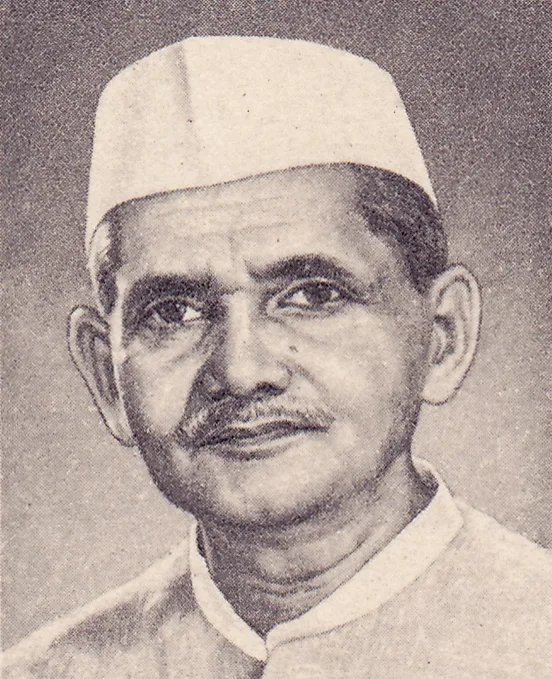
Lal Bahadur Shastri
Second Prime Minister of India (1964–1966)
- Lived
- 61 yrs
- 1904 – 1966
- Works listed
- 0
- Career highlights
- Honours
- 1
- Most recent 1966
- Profile views
- 1
- 0 followers
Lal Bahadur Shastri succeeded Jawaharlal Nehru as Prime Minister and led India through the 1965 war with Pakistan. Known for his modesty and integrity, he coined the slogan “Jai Jawan Jai Kisan” and backed the policies that started India’s Green and White Revolutions.
Biography
Early life
Shastri lost his father as an infant and was raised by his mother’s family in modest circumstances. He left school as a teenager to join Gandhi’s Non-Cooperation Movement and later studied at Kashi Vidyapith in Varanasi, which awarded him the title “Shastri” (scholar) in 1925. He was jailed for about nine years in total during the freedom struggle.
Minister
After independence he served as a minister in Uttar Pradesh and then in the Union cabinet, as Minister of Railways, Transport, Commerce and Home Affairs. In 1956 he resigned as Railway Minister, accepting moral responsibility for a fatal train accident — a gesture still cited as an example of political integrity.
Prime Minister
Chosen to succeed Nehru in June 1964, Shastri faced food shortages and the 1965 war with Pakistan. He rallied the country with the slogan “Jai Jawan Jai Kisan” (Hail the soldier, hail the farmer), supported the high-yield agriculture programme that became the Green Revolution, and backed the creation of the National Dairy Development Board.
He died suddenly of a heart attack in Tashkent on 11 January 1966, a day after signing the Tashkent Declaration with Pakistan’s President Ayub Khan. He was the first person to be awarded the Bharat Ratna posthumously.
Integrity
Stories of Shastri’s simplicity are part of Indian political folklore: he took a loan to buy a car while Prime Minister, which his widow repaid from her pension after his death, and he refused privileges for his family. He was widely trusted as a consensus-builder within the Congress.
Death in Tashkent
Shastri died of a heart attack in the early hours of 11 January 1966, hours after signing the Tashkent Declaration ending the 1965 war. The suddenness of his death and the lack of a post-mortem in the Soviet Union fuelled long-running speculation in India, though official inquiries found no foul play. His memorial in Delhi is Vijay Ghat.
Timeline
-
1904
Born in Mughalsarai, United Provinces (now Uttar Pradesh)
-
1921
Joins the Non-Cooperation Movement
Leaves school at 16 to join the national movement.
-
1925
Graduates from Kashi Vidyapith
Receives the title “Shastri”.
-
1928
Marries Lalita Devi
-
1937
Elected to the United Provinces assembly
-
1947
Minister of Police and Transport, Uttar Pradesh
Introduces women conductors on buses.
-
1952
Union Minister of Railways
Joins Nehru’s cabinet.
-
1956
Resigns after a rail accident
Accepts moral responsibility.
-
1961
Union Home Minister
Serves until 1963.
-
1964
Becomes Prime Minister
Sworn in on 9 June after Nehru’s death.
-
1965
War with Pakistan
Coins “Jai Jawan Jai Kisan”.
-
1965
Supports the creation of the National Dairy Development Board
-
1966
Tashkent Declaration; dies in Tashkent
Peace agreement signed on 10 January.
-
1966
Died, aged 61
Awards and honours
-
Bharat Ratna
1966 · The first posthumous recipient.
In their own words
“Jai Jawan Jai Kisan.”
Did you know?
-
1
He shares his birthday, 2 October, with Mahatma Gandhi.
-
2
During the food crisis he asked citizens to skip one meal a week.
-
3
His memorial in Delhi is called Vijay Ghat.
-
4
He dropped his caste surname, Srivastava, as a young man.
-
5
He took a bank loan to buy a car while Prime Minister.
-
6
As a minister in Uttar Pradesh he introduced women bus conductors.
Gallery
Connections
Related people
Frequently asked
Who is Lal Bahadur Shastri?
Lal Bahadur Shastri succeeded Jawaharlal Nehru as Prime Minister and led India through the 1965 war with Pakistan. Known for his modesty and integrity, he coined the slogan “Jai Jawan Jai Kisan” and backed the policies that started India’s Green and White Revolutions.
When did Lal Bahadur Shastri die?
Lal Bahadur Shastri died on 11 January 1966 at the age of 61.
Where is Lal Bahadur Shastri from?
Lal Bahadur Shastri was born in Mughalsarai, United Provinces (now Uttar Pradesh).
What is Lal Bahadur Shastri known for?
Lal Bahadur Shastri is best known for “Jai Jawan Jai Kisan”, leadership during the 1965 war, the Tashkent Declaration.
What awards has Lal Bahadur Shastri received?
Notable honours include Bharat Ratna (1966).
Who is Lal Bahadur Shastri married to?
Spouse: Lalita Shastri.
References
- Lal Bahadur Shastri — Wikipedia. Wikipedia. Retrieved 26 October 2026.
- Lal Bahadur Shastri — Britannica. Encyclopaedia Britannica. Retrieved 26 October 2026.
- Lal Bahadur Shastri — IMDb. IMDb. Retrieved 26 October 2026.
- Lal Bahadur Shastri — Hindi Wikipedia. Wikipedia (Hindi). Retrieved 26 October 2026.
- Lal Bahadur Shastri (Q244689) — structured data. Wikidata. Retrieved 26 October 2026.
External links
About this profile
- Researched by the TrackFame editors; reviewed by Sanjay Sokal
- First published 26 October 2026
- Last updated
Cite this page
“Lal Bahadur Shastri.” TrackFame, last updated 26 October 2026. https://trackfame.com/person/lal-bahadur-shastri
Discussion 0
Sign in or create an account to join the discussion.
No comments yet — be the first.
More in Politics & Leadership
 Politics & Leadership
Rajiv Gandhi
Sixth Prime Minister of India (1984–1989)
1944 – 1991
 Politics & Leadership
Subhas Chandra Bose
Freedom fighter and leader of the Indian National Army
1897 – 1945
 Politics & Leadership
Mahatma Gandhi
Leader of India’s independence movement and pioneer of non-violent resistance
1869 – 1948
 Politics & Leadership
Vallabhbhai Patel
First Deputy Prime Minister and Home Minister of India
1875 – 1950
 Politics & Leadership
Manmohan Singh
Thirteenth Prime Minister of India (2004–2014) and architect of the 1991 reforms
1932 – 2024
 Politics & Leadership
Jawaharlal Nehru
First Prime Minister of India (1947–1964)
1889 – 1964